Atticus Finch
Atticus Finch is the moral center of Harper Lee's To Kill a Mockingbird, a principled lawyer and single father who defends a black man, Tom Robinson, against a false rape charge in the racially segregated town of Maycomb, Alabama, and who teaches his children, Scout and Jem, the values of empathy, integrity, and courage in the face of prejudice. His quiet, consistent decency and his willingness to stand against the overwhelming bigotry of his community define the novel's central conflict and its deepest lessons about justice and conscience.
Identity and Background
Atticus Finch is a widower and the father of Jem and Scout. He is nearly fifty years old, which his children consider feeble, and he is nearly blind in his left eye, a condition he calls the tribal curse of the Finches. He works as a lawyer in an office, does not hunt, fish, drink, or smoke, and spends his evenings reading. To his children's initial embarrassment, he seems to do nothing that could arouse admiration. He is also the brother of Aunt Alexandra and Uncle Jack Finch, and a descendant of Simon Finch, who built Finch's Landing. Atticus is a member of the Alabama state legislature, and he is known in his youth as "Ol' One-Shot," the deadest shot in Maycomb County, a talent he keeps hidden from his children until he is forced to use it to kill a rabid dog.
Life and Plot Trajectory
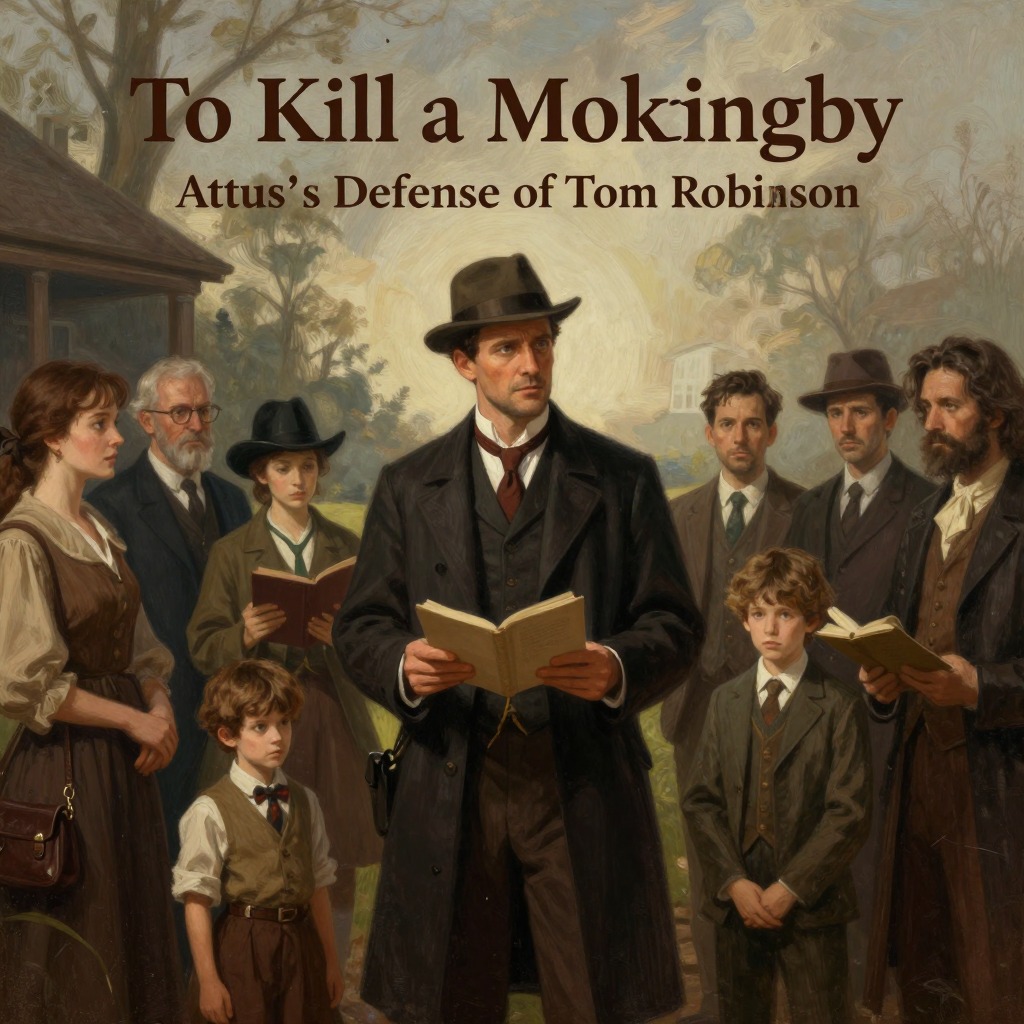
Atticus's life is defined by his decision to defend Tom Robinson, a black man accused of raping Mayella Ewell. He explains to Scout that he must take the case because if he didn't, he "couldn't hold up my head in town, couldn't represent this county in the legislature, couldn't even tell you or Jem not to do something again." He knows from the outset that they will lose, telling Scout, "Simply because we were licked a hundred years before we started is no reason for us not to try to win." His defense of Robinson makes him the target of the town's scorn, and his children are taunted at school. He endures this with patience, instructing Scout to "hold your head high and keep those fists down." He also navigates the arrival of his sister, Aunt Alexandra, who moves in to provide a "feminine influence" and who pressures him to instill a sense of family pride in the children, a task he performs awkwardly and then abandons.
Key Actions and Objectives
Atticus's primary objective is to raise his children to be just and empathetic, and to do his duty as a lawyer by providing Tom Robinson with the best possible defense. He teaches Scout the importance of understanding others by telling her, "You never really understand a person until you consider things from his point of view... until you climb into his skin and walk around in it." He also teaches Jem a profound lesson about courage through the example of Mrs. Dubose, a morphine addict who determines to break her addiction before she dies. Atticus tells Jem, "I wanted you to see what real courage is, instead of getting the idea that courage is a man with a gun in his hand. It's when you know you're licked before you begin but you begin anyway and you see it through no matter what." He also establishes a key moral rule for his children: "it's a sin to kill a mockingbird," a principle Miss Maudie explains by noting that mockingbirds "don't do one thing but make music for us to enjoy." He forbids Scout from fighting, and he himself refuses to retaliate against the town's insults, demonstrating a quiet, principled strength.
Relationships and Conflict
Atticus's most significant relationship is with his children, whom he treats with respect and honesty. He listens to both sides of an argument, as Scout notes, and he trusts them to come to him for answers. He is also a respected employer to Calpurnia, who has been with the family since Jem was born. His relationship with his sister, Aunt Alexandra, is one of affectionate but firm tolerance; he gently resists her attempts to impose her rigid social views on his household. His central conflict is with the racist society of Maycomb, personified by Bob Ewell, who accuses Tom Robinson, and by the townspeople who call Atticus a "nigger-lover." He also faces conflict from within his own family when his cousin, Francis Hancock, uses the same slur. Atticus's response to this hostility is to remain calm and to explain that such words are used by "ignorant, trashy people" and are not an insult to the person they are aimed at. He also has a professional relationship with Sheriff Heck Tate, who insists that Atticus shoot the rabid dog because of his superior marksmanship.
Change and Ending
Atticus does not undergo a dramatic personal transformation; rather, he remains a steady, unchanging moral compass throughout the novel. His children, however, are transformed by their observations of him. After he shoots the mad dog, Jem realizes his father is not feeble but a man of hidden talents and profound restraint. After the trial, Scout reflects on the injustice of the verdict but also on the dignity with which her father conducted himself. Atticus's final significant act is to accept Sheriff Tate's decision to protect Boo Radley from the public scrutiny that would follow Bob Ewell's death, agreeing that "Jem never stabbed Bob Ewell" and that bringing Boo into the spotlight would be "like shootin' a mockingbird." This decision underscores his consistent commitment to protecting the innocent.
Narrative Role and Evaluation
Atticus Finch functions as the novel's moral exemplar and its primary vehicle for thematic instruction. He is a round character in E.M. Forster's terms, capable of surprising the reader with his hidden marksmanship and his complex understanding of courage. He is the character through whom the novel's central themes of justice, empathy, and moral integrity are articulated and enacted. His role is to provide a stable, principled counterpoint to the prejudice and hypocrisy of Maycomb, and to guide his children—and the reader—toward a more compassionate and just understanding of the world. His famous dictum about not killing a mockingbird becomes the novel's central metaphor for the protection of innocence, and his definition of courage as persevering against certain defeat provides the novel's ethical framework.